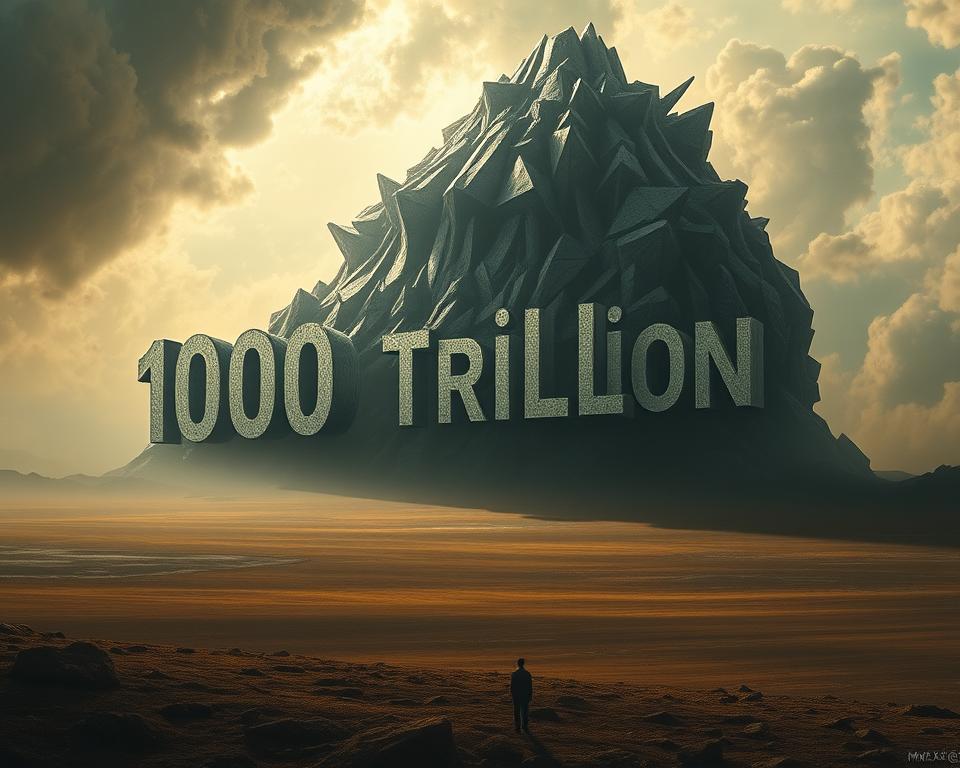

Imagine a stack of $1 bills reaching the moon. That’s about $435 billion. But what about numbers like trillion or quadrillion? Can you really understand the difference between a billion and a trillion?
These huge numbers affect everything from national debts to tech values. Yet, most people find it hard to picture their size. The quadrillion stars in our galaxy? The trillion dollars in global GDP? This journey explains how these numbers shape our economies, science, and everyday life.
Key Takeaways
- Large numbers like billion, trillion, and quadrillion are key in global finance and science.
- People often get these scales wrong, leading to mistakes in policy and finance.
- Old systems like Vedic mathematics helped create our modern number systems.
- Today, costs for climate and tech investments often reach into the trillion-dollar range.
- Grasping these scales helps us make better financial choices and stay informed as citizens.
Understanding the Basics of Large Numbers
Learning about billion, trillion, and quadrillion helps us understand big numbers. This knowledge is key for making sense of financial reports, scientific studies, and global trends. It shows us patterns in stock markets and how much resources planets have.
These numbers are crucial for analyzing budgets, populations, and new technologies. They help us see how much money countries spend and how many people live in the world.
| Term | Numeric Value | Zeros | Exponential Form | Example |
|---|---|---|---|---|
| Billion | 1,000,000,000 | 9 | 109 | Global internet users reached 5 billion in 2023. |
| Trillion | 1,000,000,000,000 | 12 | 1012 | U.S. federal debt exceeds $30 trillion. |
| Quadrillion | 1,000,000,000,000,000 | 15 | 1015 | Earth’s total bacteria count is estimated at 5×1030 – far larger, but quadrillion scales appear in energy consumption forecasts. |
Definition of a Billion
A billion is 1,000,000,000. It’s used to measure big things like population sizes (e.g., India’s population near 1.4 billion) and company values (e.g., Apple’s market cap over $3 trillion in 2023). Knowing how to convert between these numbers helps us understand their size.
Definition of a Trillion
A trillion is 1,000,000,000,000. It’s used for huge numbers like national budgets, climate change costs, and tech industry values. For example, in 2022, global renewable energy investments were $1.3 trillion.
Definition of a Quadrillion
A quadrillion is 1,000,000,000,000,000 (1015). This number is less common but shows up in big cosmic calculations (e.g., stars in the Milky Way) and in economic models looking ahead centuries.
Historical Context of Large Numbers
Humans have been dealing with numbers for thousands of years. The first civilizations, like the Babylonians and Egyptians, started tracking trade and wealth. These early steps helped us understand and work with big numbers.
Origins of Numerical Systems
The Babylonians used a base-60 system for more complex math. The Egyptians wrote numbers up to a million with hieroglyphs, as shown in the Rhind Mathematical Papyrus. These systems helped track resources and taxes, showing how numbers were used for society.
Historical Usage of Large Numbers
“Numbers rule the universe,” Pythagoras said, showing their importance. In the Middle Ages, merchants and scholars found Roman numerals hard to use for big numbers. The introduction of Arabic numerals (0-9) changed everything, making it easier to calculate trade and population.
The Evolution of Economic Measurements
- Pre-Decimal Era: Before the decimal system, tracking money was hard. In 13th-century England, taxes were counted in “marks” and “pounds” without clear big number symbols.
- Decimal Revolution: In the 16th century, Europe moved to decimal systems, making financial records easier. By the 18th century, Britain’s GDP was £70 million, showing a big change in measuring the economy.
- Modern Frameworks: Now, we talk about GDP and national debts in trillions. This shows how far we’ve come from using clay tablets to digital databases.
This journey shows how numbers went from being abstract to being key in shaping economies and policies worldwide.
The Importance of Large Numbers in Economics
Large numbers are key to understanding economies. They help track national productivity and financial health.
“A billion here, a billion there, and pretty soon you’re talking about real money.” — Former Senator Everett Dirksen
GDP and Economic Indicators
The U.S. GDP hit $25.5 trillion in 2023. This shows its economic strength. It helps governments plan and compare progress.
National Debt and Its Implications
| Year | U.S. Federal Debt (Trillion $) |
|---|---|
| 2000 | 5.7 |
| 2020 | 27.7 |
| 2023 | 34.0 |
Debt in trillions shows big fiscal challenges. Daily interest payments on U.S. debt are over $1 billion. These numbers guide spending and tax policies.
Wealth Distribution Among Nations
- Top 1% hold 32% of global wealth (Credit Suisse, 2023)
- U.S. wealth gaps: 40% of households lack $400 for emergencies
Large numbers show big wealth gaps. Global financial assets are in quadrillions, yet many struggle financially. This highlights the need for policies based on data.
Comparing Billion, Trillion, and Quadrillion Values
When we compare billion, trillion, and quadrillion values, counting digits is key. A billion has 1 followed by nine zeros. A trillion has three more zeros, and a quadrillion has six. These numbers are important in finance, science, and daily life.
Conversion between Different Metrics
Converting these numbers needs careful math. For instance, 1 trillion is the same as 1,000 billion. Scientists use these conversions to measure things like Earth’s circumference (about 40 million meters) or global digital data—estimated at 181 zettabytes by 2025. Here’s how:
- 1 billion seconds = 31.7 years
- 1 trillion seconds = 31,709 years
Applications in Everyday Life
Financial deals depend on accurate counting. The U.S. federal budget is over $6 trillion a year. Tech giants like Apple or Amazon report billions in revenue. Even simple data, like social media’s 3.8 billion users, relies on understanding scale.
Understanding Scale and Magnitude
Seeing scale helps us understand these numbers. A stack of one billion $100 bills would be 68 miles high. AI systems can do quadrillion calculations per second. Counting digits helps us see how governments handle debt or tech innovates at huge scales.
Large Numbers in Science and Technology
Scientific discoveries and tech advancements depend on mathematical terms to understand the universe. They help us figure out cosmic distances and process huge datasets. This leads to new research and innovations.
Applications in Scientific Research
Scientists use big numbers like 10²² atoms in a grain of sand or 200 billion galaxies. Mathematical terms make these numbers easier to work with in equations and models.
- Particle physics: Calculating subatomic interactions
- Climate modeling: Simulating decades of environmental data
- Genomics: Mapping DNA sequences with billions of base pairs
The Role of Large Numbers in Data Analysis
Data centers handle petabytes of info every day—like 20 million 100-page books. Algorithms use mathematical terms to spot patterns in huge datasets. This helps predict trends in healthcare, finance, and AI.
Large Numbers in Space and Astronomy
“Without mathematical terms, we couldn’t map the cosmos.”
Astronomers say the Milky Way is 100,000 light-years wide—over 588 quadrillion miles. Telescopes like the Hubble use these numbers to study the universe. They help us understand supernovae and the universe’s age (13.8 billion years).
Global Perspectives on Wealth: Billionaires and Beyond
Global wealth shows big differences. Forbes’ 2023 list has over 2,700 billionaires, with some having over $10 billion. This shows how wealth is mostly in a few hands, affecting economies and charity.
Billionaires Around the World
People like tech leaders and stars like Taylor Swift have billions. Elon Musk’s $200+ billion shows the top of wealth. But, wealth varies by region—Asia saw a 12% rise in billionaires in 2022.
The Rise of Ultra-High-Net-Worth Individuals
- Ultra-HNWIs now hold over $35 trillion in assets.
- Emerging markets contribute 40% of new entrants into the billionaire club.
- Wealth accumulation trends suggest future trillion-dollar individual fortunes could emerge.
Philanthropy and Its Impact
“Philanthropy is a moral responsibility.” — Bill Gates
The Bill and Melinda French Gates Foundation gave $60 billion to health causes. Such efforts could have a trillion-dollar effect. Yet, the top 1% own nearly 45% of the world’s quadrillion-scale assets. Managing wealth well is key to solving inequality.
Notable Economic Events Involving Large Numbers
Big numbers play a huge role in the world economy. Things like financial crashes and recovery efforts need exact number conversion to see their effects. The 2008 crisis, for example, made trillions disappear from markets, changing policies everywhere.
Financial Crises and National Debt
National debt numbers are often in the trillions. The U.S. debt hit over $30 trillion in 2023. Using number conversion between GDP and debt helps figure out risks:
| Year | National Debt (Trillions) |
|---|---|
| 2000 | $5.7 |
| 2008 | $10.0 |
| 2023 | $32.3 |
Major Investments and Economic Booms
Technology booms lead to huge investments. Areas like AI and renewable energy now get trillions each year. Key areas include:
- Global tech investments: $3.5 trillion (2022)
- Renewable energy funding: $1.4 trillion (2023 projections)
- Infrastructure spending: $6 trillion+ in G20 nations
The 2008 Financial Crisis Revisited
“The crisis exposed gaps in understanding scale,” noted economists. Bailout packages reached $700 billion, but losses totaled trillions when converted across global markets.
Getting number conversion right between currencies and metrics showed hidden risks. Recovery efforts needed to adjust fiscal policies to trillion-dollar scales.
Challenges in Comprehending Large Values
Understanding big numbers like billions and trillions is hard. It’s not just about math. Our brains, how media reports, and school education all play a part. We need clear talk and better learning about numbers to get it right.

Cognitive Limitations of Understanding Scale
Our brains find it tough to picture huge numbers. Research shows we often think 1 million is closer to 1,000 than 1 billion. This makes us judge risks or policy effects wrongly.
For example, during the pandemic, people didn’t fully grasp the impact of 1 million deaths. This was because they found it hard to compare such big numbers.
- People underestimate exponential growth between millions and billions
- Misjudging proportions leads to flawed risk assessments
- Visual tools like logarithmic scales improve comprehension
Misrepresentation in Media and Politics
Media and politicians often change big numbers to sway opinions. They might say a $30 trillion national debt is like a household budget. This makes complex financial issues seem simple.
Such misleading comparisons can confuse people about the real effects of economic policies.
Rescaling large numbers into relatable units enhances public understanding, per a 2020 Psychological Science study.
The Role of Education in Awareness
Schools need to teach us how to understand big numbers. Learning to think critically about statistics and make comparisons helps fight false information. Schools should focus on:
- Teaching scale through everyday analogies
- Training to spot biased numerical claims
- Encouraging skepticism of unverified data
Better number skills help us participate in democracy. When we get big numbers, we can judge policies and money decisions better.
Future Trends: Will We Reach a Quadrillion?
Global economies are growing fast, pushing financial numbers to new heights. Soon, we might talk about quadrillion as a common term in finance.
Predictions for Global Economics
Economists look at GDP and trade to predict big financial moments. By 2050, the global GDP might hit over $100 quadrillion. This is thanks to tech progress and more people.
The Impact of Inflation on Large Numbers
Inflation changes the value of large numbers over time. Even if we reach quadrillion numbers, our buying power might go down. Central banks keep an eye on this to keep the economy stable.
Emerging Markets and Changing Dynamics
India and China’s fast growth shows how new markets change the economy. Their growth could make quadrillion numbers important in everyday talks.
- Technological innovation boosts productivity.
- Urbanization fuels consumer demand.
- Global trade networks expand economic reach.
The Role of Large Numbers in Everyday Finances
Large numbers like billions or trillions might seem hard to understand. But, knowing them is key in managing our money. It helps us with budgeting and keeping track of our savings.
When we calculate our net worth, we start with our assets. For example, a $500,000 home adds six digits to our net worth. On the other hand, credit card debt takes away from our totals. Tools like Mint or You Need A Budget (YNAB) make it easier to keep an eye on these numbers every day.
- Track income vs. expenses to balance budgets
- Automate savings to grow wealth incrementally
- Adjust spending to match long-term goals
“Inflation erodes purchasing power, making counting digits critical for preserving savings,” says financial advisor Sarah Johnson of Better Money Habits. “A 3% annual inflation rate reduces the value of $100,000 to $97,000 in one year.”
Inflation’s effect grows over time. Saving $1 million requires careful counting. Today’s $1,000 emergency fund could drop to $800 in a decade without growth. Apps like Bankrate’s inflation calculator show how small percentages can affect savings over decades.
Good financial planning means seeing how our daily choices add up. Whether saving for college or retirement, counting digits in our monthly budgets helps build habits for long-term stability. Small changes today can help us reach our goals involving seven or eight-digit figures.
Environmental Concerns: The Cost of Climate Change
Climate change has a big economic price tag. Experts use models to figure out the damage from rising temperatures and extreme weather. These mathematical terms show how environmental damage costs money.
Economic Valuation of Environmental Impact
Scientists and economists use math to estimate costs. For example, a 2023 study by the IPCC found global warming could cut GDP by 10% by 2050. They use mathematical terms like discount rates and risk assessments.
The Financial Burden of Natural Disasters
Recent disasters show the rising costs:
- Hurricane Ian (2022): $112 billion in damages
- California wildfires (2020): $20 billion
- Global flood costs (projected by 2050): $1 trillion/year
Insurance models and actuarial tables help predict future risks.
Investing in Sustainable Solutions
Switching to renewable energy needs big investments. A table shows:
| Technology | Initial Cost | Long-term Savings |
|---|---|---|
| Solar farms | $1 billion | $500 million/year |
| Carbon capture | $3 billion | $2 billion/year |
These figures use mathematical terms like ROI and net present value to justify spending.
Understanding these numbers helps policymakers and businesses make sustainable choices. Mathematical terms turn abstract threats into real data.
Social Media and Large Numbers: A New Era

Billions of users scroll through feeds every day. They turn follower counts into big money. Sites like Instagram and TikTok are home to creators who reach billions, changing how we measure influence.
- Top influencers make millions a year from sponsorships, with the industry making over $10 billion.
- Ads on social media make billions for companies like Meta and Google every year.
- Live streams and digital content open up new chances to reach billions worldwide.
| Metric | Example | Value |
|---|---|---|
| Ad Revenue | Facebook’s 2023 earnings | $116 billion |
| Event Fundraising | ALS Ice Bucket Challenge | Raised over $220 million, impacting billions through awareness |
| Influencer Marketing | Global industry growth | Projected to hit $13.8 billion by 2025 |
Viral trends like challenges or memes can make billions in sales. A 2023 report said platforms handle trillions of interactions daily. This shapes market strategies.
Now, making money online goes beyond ads. Creators earn from microtransactions and subscriptions, adding to platforms’ billions in value. As people engage more, the difference between socializing and making trillions in the economy gets smaller.
The Intersection of Politics and Large Numbers
Politics deals with huge budgets and policies. Numbers like billions and trillions are common. Using number conversion tools helps leaders explain these big figures to the public.
Budget Allocations and Public Policy
The U.S. federal budget for 2023 was over $6 trillion. Number conversion makes it easier to talk about these huge numbers. It helps turn trillions into costs for each person.
- Defense spending: Over $800 billion annually
- Healthcare allocations: $1.5 trillion in 2023
- Infrastructure projects: Billions directed to transportation and energy
Taxation and Revenue Generation
“Accurate number conversion turns abstract figures into actionable policies.” — Congressional Budget Office Analyst
Taxes fill the national treasury. In 2022, the IRS collected $4.8 trillion. Turning these numbers into specific allocations makes things clear. For example, raising taxes by 1% on the rich could bring in $20 billion a year.
Political Campaigns and Financial Backing
Today’s campaigns need to track big money. The 2020 presidential race cost over $14 billion. Teams use number conversion to:
- Track donations from millions to billions
- Compare state vs. federal funding scales
- Forecast voter impact of spending shifts
Without clear number conversion, there’s a risk of miscommunication. This can hurt public trust in government.
Conclusion: The Significance of Understanding Large Numbers
Learning about big numbers is more than just math. It affects our economy, environment, and personal lives. Knowing about billions and trillions helps us make smart choices in today’s data-filled world.
Implications for Future Generations
Today’s youth are dealing with digital money and big risks. Studies show that better math skills can lead to more wealth. Schools need to focus on these skills to prepare future leaders for big challenges.
Promoting Financial Literacy
In the U.S., many adults struggle with basic money knowledge. This makes it hard to understand risks like inflation or how to invest. Teaching math skills in school can help fix this problem. It prepares people to manage their money better and avoid scams.
Responsible Financial Management
Handling money wisely is key, whether it’s at home or in government policies. Better math skills help us see the risks and benefits clearly. This way, we can avoid debt and help create fair economic plans for everyone.
FAQ
What is the difference between a billion, trillion, and quadrillion?
A billion is 1,000,000,000 or 10^9. A trillion is 1,000,000,000,000 or 10^12. A quadrillion is 1,000,000,000,000,000 or 10^15. The main difference is the number of zeros. A billion has nine, a trillion has twelve, and a quadrillion has fifteen.
How are large numbers relevant in everyday life?
Large numbers are key in finance, science, and economics. They help us understand national budgets, GDP, and wealth. Knowing these numbers helps us make better choices and understand the economy.
Why is it important to understand large numbers in economics?
Large numbers help us understand important economic indicators like GDP and national debt. They show how stable a country’s finances are. This knowledge is crucial for making good economic decisions.
How have ancient cultures approached large numbers?
Ancient cultures had their own ways to deal with big numbers. They used these numbers for trade and managing resources. For example, the Babylonians used a base-60 system, which helped lay the foundation for our current numbers.
What are some challenges in comprehending large numbers?
It can be hard for people to understand numbers that are much bigger than what they see every day. This can lead to misunderstandings. Education can help improve our understanding of these numbers.
How do large numbers relate to climate change issues?
Large numbers help us understand the economic effects of climate change. They show the costs of disasters and the need for sustainability. Recognizing these numbers highlights the urgency of the problem.
What trends could bring us to quadrillion-level figures in economics?
Experts predict that inflation and global economic changes could soon require us to deal with quadrillion figures. This is likely to happen in national economies and financial systems.
How can individuals apply concepts related to large numbers in personal finance?
People can use large numbers to plan their budgets and savings. Understanding these numbers helps with financial management. It allows for better decision-making.
What role do large numbers play in social media and digital marketing?
In social media, large numbers show follower counts and engagement. These numbers are key for making money and planning ads. Knowing these figures helps businesses improve their marketing.
How do governments utilize large numbers in public policy?
Governments use large numbers for budgeting and taxation. They also use them for campaign financing. Accurate conversion of these numbers is crucial for managing finances.